


 Cart
Cart
 sales@molnova.com



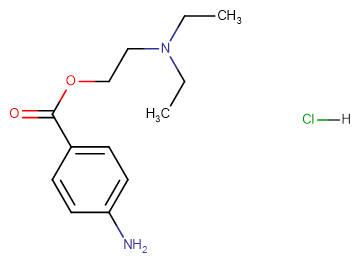
Procaine hydrochloride
CAS No. 51-05-8
Procaine hydrochloride( Novocaine )
Catalog No. M14757 CAS No. 51-05-8
A local anesthetic of the ester type that has a slow onset and a short duration of action. It is mainly used for infiltration anesthesia, peripheral nerve block, and spinal block.
Purity : >98% (HPLC)
 COA
Datasheet
HNMR
HPLC
MSDS
Handing Instructions
COA
Datasheet
HNMR
HPLC
MSDS
Handing Instructions
| Size | Price / USD | Stock | Quantity |
| 500MG | 38 | In Stock |


|
| 1G | 45 | In Stock |
|
Biological Information
-
Product NameProcaine hydrochloride
-
NoteResearch use only, not for human use.
-
Brief DescriptionA local anesthetic of the ester type that has a slow onset and a short duration of action. It is mainly used for infiltration anesthesia, peripheral nerve block, and spinal block.
-
DescriptionA local anesthetic of the ester type that has a slow onset and a short duration of action. It is mainly used for infiltration anesthesia, peripheral nerve block, and spinal block.(In Vitro):Procaine hydrochloride (0.01-100 microM) inhibited the 5-HT3 receptor-mediated inward current in the whole-cell patch clamp recording. Procaine appears to produce a competitive inhibition on 5-HT3 receptors with a KD of 1.7 microM. Procaine is a DNA-demethylating agent that produces a 40% reduction in 5-methylcytosine DNA content as determined by high-performance capillary electrophoresis or total DNA enzyme digestion. Procaine can also demethylate densely hypermethylated CpG islands. Procaine also has growth-inhibitory effects in these cancer cells, causing mitotic arrest. Procaine functions as an excitant of limbic system cells, and that procaine alters synaptic transmission in some, but not all, output pathways from the amygdale.
-
In VitroProcaine hydrochloride (0.01-100 microM) inhibited the 5-HT3 receptor-mediated inward current in the whole-cell patch clamp recording. Procaine appears to produce a competitive inhibition on 5-HT3 receptors with a KD of 1.7 microM. Procaine is a DNA-demethylating agent that produces a 40% reduction in 5-methylcytosine DNA content as determined by high-performance capillary electrophoresis or total DNA enzyme digestion. Procaine can also demethylate densely hypermethylated CpG islands. Procaine also has growth-inhibitory effects in these cancer cells, causing mitotic arrest. Procaine functions as an excitant of limbic system cells, and that procaine alters synaptic transmission in some, but not all, output pathways from the amygdale.
-
In Vivo——
-
SynonymsNovocaine
-
PathwayEndocrinology/Hormones
-
Target5-HT Receptor
-
Recptor5-HT3| nAChR| NMDA receptor| Sodium channel
-
Research AreaNeurological Disease
-
Indication——
Chemical Information
-
CAS Number51-05-8
-
Formula Weight272.77
-
Molecular FormulaC13H20N2O2·HCl
-
Purity>98% (HPLC)
-
SolubilityWater: 55 mg/mL (201.63 mM); DMSO: 55 mg/mL (201.63 mM)
-
SMILESO=C(OCCN(CC)CC)C1=CC=C(N)C=C1.[H]Cl
-
Chemical NameBenzoic acid, 4-amino-, 2-(diethylamino)ethyl ester, monohydrochloride
Shipping & Storage Information
-
Storage(-20℃)
-
ShippingWith Ice Pack
-
Stability≥ 2 years
Reference
1. Fan P, Weight FF. Neuropharmacology. 1994 Dec;33(12):1573-9.
molnova catalog



related products
-
SB 203186 hydrochlor...
SB 203186 hydrochloride is a potent 5-HT4 receptor antagonist.
-
MDL 100009
MDL 100009, the S-enantiomer of MDL 100151 and the opposite enantiomer of MDL 100907, is a selective antagonist of 5-HT2A.
-
Bilastine
Bilastine is a novel new-generation antihistamine that is highly selective for the H1 histamine receptor, has a rapid onset and prolonged duration of action.
